Home Blog Page 1776

Just in: Senate to screen Buhari supporter, Lauretta Onochie as INEC commissioner

0

Senate President Ahmad Lawan has asked the committee on the Independent National Electoral Commission (INEC) to screen Lauretta Onochie, a presidential aide, and five others as national commissioner of the electoral body.

At the Senate plenary on Wednesday, Yahaya Abdullahi (Kebbi North) asked the Senate to consider the request of President Buhari on the confirmations of the nominees as commissioners of INEC in accordance with paragraph 14 part I(F) of the third schedule to the 1999 constitution of the federal republic of Nigeria as amended.

Other nominees are Prof Muhammad Sani Kallah (Commissioner, Katsina); Prof Kunle Cornelius Ajayi (Commissioner, Ekiti); Said Babura Ahmad (Commissioner, Jigawa); Prof Sani Muhammad Adam (Commissioner, north-central) and Dr Baba Bills (Commissioner, north-east) while Onochie will represent Delta State.

But before seconding the motion raised by the Senate leader, the Minority leader of the Senate, Enyinnaya Abaribe, asked questions over the appointment of Buhari’s aide, Onochie, who is a card-carrying member of the ruling APC.

“She was rejected but her name have been repacked and has resurface as Commissioner from Delta State,” Abaribe said.

Speaking, the Senate president Ahmad Lawan, said all the nominees are national commissioner-nominees, adding that there is no change of request from the president.

“The request is hereby referred to the committee on INEC to report back in two weeks,” Lawan ruled.

Onochie alongside the five others were nominated and forwarded by President Muhammadu Buhari to the Senate for confirmation in October 12 2020.

The nomination drew a lot of outrage from Nigerians as Onochie was not only a social media aide to Mr Buhari but she is also a staunch member of the All Progressive Congress and Buhari-led administration.

NTA Bauchi calls for Police boycott over assault on staff

0

Nigerian Television Authority (NTA) in Bauchi State has called on media organisations to boycott all activities of the state command of the Nigeria Police Force.

NTA’s general manager, Alhaji Sulaiman Ibrahim Ahmad on Tuesday, said the boycott is as a result of “senseless and bodily assault meted against its staff, Halliru Ahmed, in the course of conducting his lawful duty at the Abubakar Tafawa Balewa Stadium (ATBS), Bauchi.”

He said, “Sunday 6th June, 2021 will go down in the history of our profession in Bauchi when an honest young journalist left NTA office, armed with nothing but his camera, microphone and jotter, and of course driver, the desire to bring information to the sitting rooms of Nigerians residing in Bauchi”.

Sulaiman said the NTA reporter, Halliru Ahmed on arrival at the Abubakar Tafawa Balewa Stadium demanded access to the main bowl of the stadium to cover a match between Wikki Tourist and Akwa United.

He narrated, “Without any form of provocation by the reporter, a policeman by simple name Dauda manning the post of the stadium removed his belt and started beating the defenceless, innocent journalist who in bewilderment, continued to ask the policeman what he had done wrong.”

Alhaji Sulaiman Ahmad explained that this act of unprovoked and unwarranted physical assault on the reporter is not only unacceptable, but stands unreservedly condemned, describing it as blatant attack on the media generally and by extension attack on the nation’s democracy.

Prosecution of twitter users “will serve as a deterrence to others,” AGF Malami insists

0

Attorney General of the Federation, and Minister of Justice, Abubakar Malami has stayed true to reiterated his threat of prosecuting Nigerians who have continued to use Twitter despite a federal government’s suspension of the micro-blogging platform. 

He claims that punishing users will deter other violators from using the app. 

“The essence of the law is to achieve stability in the country” and prosecution “will serve as a deterrence to others,” Mr Malami told the Committee to Protect Journalists via a messaging app on Tuesday.

 The Federal Government last Friday suspended the operations of Twitter, the microblogging and social networking service, in Nigeria.

Lai Mohammed, Minister of information, announced the indefinite suspension in a statement.

According to the statement, the minister cited “the persistent use of the platform for activities that are capable of undermining Nigeria’s corporate existence”.

A day after the ban, Malami threatened to prosecute Nigerians who were still using the Virtual Private Networks to access Twitter even though no Nigerian law makes it illegal to tweet.

But he defied his directives and that of the Nigerian Government on Tuesday when he deactivated his account. This is because it is impossible to deactivate an account without logging into the platform.

The majority of Twitter users including politicians, news agencies and civil societies have disregarded the federal government’s directive and have continued to access Twitter through the use of VPN and other settings on their phones.

They claim the directive of the federal government is a mere announcement that is not backed by the law or an executive order.

FG issues travel advisory to Nigerians

0

The federal government has issued a travel advisory to Nigerians going to Brazil, India, Turkey, citing risks from COVID-19.

Boss Mustapha, Chairman of the Presidential Steering Committee (PSC) on COVID-19, disclosed this during a town hall meeting on COVID-19 vaccination for the North-East zone in Yola.

The PSC organised the meeting in collaboration with National Primary Health Care Development Agency (NPHCDA).

Mr Mustapha, represented by the environment minister Abubakar Mohammed, said, “Nigerians are strongly advised to avoid non-essential international travelling at this time, especially to countries that are showing (an) increase in the number of COVID-19 deaths.

“Consequently, any person who had visited Brazil, India, and Turkey within 14 days preceding travel to Nigeria shall be denied entry into Nigeria. Among other travelling guidelines, individuals, transporters, and airlines who abuse the guidelines shall be sanction.’’

He explained that the PSC was monitoring with keen interest the rise in cases of COVID-19 abroad.

”All governors are also advised to ensure that all returned international passengers in their respective states adhere strictly to the mandatory seven-day isolation period,” said Mr Mustapha.

The PSC chairman added that the cardinal objective of the meeting was to provide means for the government, communities, and other relevant stakeholders to discuss the ongoing COVID-19 vaccination in the country.

Mr Mustapha noted that the records available showed that the daily incident of COVID-19 in the country had reduced.

Bauchi State Governor Bala Mohammed has sacked all his commissioners

0

Bauchi State Governor, Sen Bala Mohammed has sacked all the Commissioners and a few other aides.

The dissolution of the cabinet was contained in a statement from the office of the Special Adviser to the Governor on Media and Publicity, Mukhtar Gidado who signed it and made copies available to Journalists early Wednesday morning.

According to the statement, “His Excellency, the Executive Governor of Bauchi State Sen. Bala A.Mohammed CON (Kauran Bauchi) has approved with immediate effect the dissolution of members of the State Executive Council and other political appointees.”

The statement further contained that, “that include, the Secretary to the State Government (SSG), the Chief of Staff (COS) Government House and all Special Advisers, except the following:

Special Adviser Security; Special Adviser National and State Assembly Liaison; Special Adviser Social Investment and Special Adviser Media and Publicity.”

The statement directed All Commissioners to handover the affairs of their Ministries to their respective Permanent Secretaries, while the Secretary to the State Government (SSG), the Chief of Staff (COS) Government House and other affected Special Advisers are to handover to the most senior Permanent Secretary in the Government House who is equally directed to take inventory of government property.”

Bala Mohammed while thanking the affected political appointees for their meritorious service to the State, wished them the very best in their future endeavours.

Another UNIJOS lecturer has been kidnapped

0

Another lecturer with the University of Jos in Plateau State, Dr. Dan Ella has been kidnapped by unidentified gunmen.

Dr Ella, with the Department of Theatre Arts in the institution, was abducted in the early hours of Wednesday by gunmen who attacked his residence located at Haske quarters in Lamingo community, Jos North Local Government Area of the state

NewsWireNGR gathered that the kidnapping happened at Haske quarters, behind Stanel Oil; the same community where gunmen last month kidnapped a Professor and her husband and later released them after allegedly collecting ransom.

A member of the community, Philip Gyang confirmed the latest abduction to our correspondent in Jos on Wednesday.

Gyang said that the gunmen who arrived in the community around 2am on Wednesday headed straight to the apartment of the lecturer and whisked him away after breaking their door while shooting to prevent his rescue from residents who were already terrified.

Gyang said, “What happened last night in Haske quarters was terrible. It was the sounds of gunshots that woke us up around 2am. But we could not come out when it became clear that Haske quarters was under attack by gunmen”.

“So, this morning when everyone came out, we discovered that they had taken Dr. Dan Ella away after breaking into their house. It’s really painful because this thing is happening again in the same place where a professor and her husband were kidnapped in similar circumstances last month and Dr Ella who is their neighbour was the one running around to make sure that the kidnapped husband and wife were rescued. And now, he is the one that has been abducted and no one knows where they have taken him to.” he said.

Bandits who abducted Niger State Islamiyya children have reduced the ransom to N150 million

0

The bandits who abducted 156 pupils of Salihu Tanko Islamiyya School in Tegina town of Rafi Local Government Area of Niger State 10 days ago have reduced the ransom they earlier demanded to N150 million.

The kidnappers had initially asked for a N110 million ransom, which was later hiked to N200 million before now reducing it to N150 million.

The Headmaster of the school, Alhaji Abubakar Alhassan, confirmed the new development, saying both the parents and the school authorities are confused on the next step to take.

“We are pleading with the federal and state governments to come to the assistance of these parents. “Only the government can afford the amount they are demanding,” he stated.

Alhassan, however, said the bandits allowed him to speak to one of the victims, who told him that “they are all fine.”

The headmaster said the girl, a fairly elderly one among the victims, who was also a teacher, said they were being fed with one groundnut cake (Kulikuli) daily.

He said only the Chairman of Rafi LGA, Mr. Ismaila Modibo, had visited the parents and the school during which he (Modibo) assured them that “the government will do something.”

Recall that last week, the Niger state government said that it was not unaware of the ongoing negotiation between the parents of the abducted young children, but insisted that it will not pay any ransom for the safe release of the children.

The State Deputy Governor, Alhaji Ahmed Mohammed Ketso, said to journalists that “Niger State Government is negotiating the release of the abductees and we are confident that in no distant time the young children will be united with their parents.

Investigation: Nigerian Journalist, Pelumi Onifade and the Shrinking Civic space

On October 24, 2020, Pelumi Onifade, a journalist intern at Gboah TV, was one of those assigned to cover the unrest at Oko-Oba area of Agege, Lagos. Police officers attached to the Lagos State Task Force arrived at the scene and started shooting live rounds to disperse the crowd. Pelumi was hit. Although still alive, according to his colleague, who went to the officers to identify Pelumi as a journalist and pointed out that he was putting on a press jacket, Pelumi was carried away in the Task Force van. After six days of searching, his family found his body at the mortuary of Lagos State General Hospital in Ikorodu.

Pelumi was the youngest Nigerian journalist in recent memory to get killed by security agents. However, between October and now, there have been several cases of assault and brutalization against journalists and media houses in Nigeria. If one turns to look back on Nigeria’s history, one would see several documented cases of security forces harassing and disappearing journalists.

Press freedom is a vital component of civic space. Its capacity for advocacy and ability to influence political issues is continually trampled upon. According to this Amnesty report, “between January and September 2019, at least 19 journalists and media practitioners suffered attack.” These attacks can be physical or verbal, which often have psychological and emotional impact on the journalists.

Last year, Femi Fani-Kayode, the former Minister of Culture and Tourism, was inspecting state government projects around the country. Each one ended with a press conference. Eyo Charles, one of the journalists at the conference in Calabar, asked that Fani-Kayode disclose who was bankrolling him. It would appear he did not like the question, an important one that required an answer. For over two minutes, he lashed out at the journalist, calling him “stupid,” saying he had a short fuse, that the journalist’s question was “insulting” and he should report himself to his publisher.

In July 2016, Jones Abiri, the publisher of Weekly Source, was arrested for publishing an article on oil blocs in Nigeria. It wasn’t until August 2018 that he was released. Eight months later, the DSS re-arrested him and he was charged with cybercrime, terrorism, petroleum production and sabotage. He told Amnesty International that the DSS wanted him to “confess that I was the leader of a group called Joint Niger Delta Liberation Force, a group I had no idea, concern or knowledge about.”

Mary Ekere, a journalist with The Post Newspaper, was arrested and detained in Uyo for taking photographs of brutality by state officials. Jaa’far Jaa’far, an investigative journalist and editor-in-chief of Daily Nigerian, is facing charges for publishing videos of a Nigerian governor receiving a five million dollars bribe. “If freedom of expression or freedom of information is stifled,” he said, “then the government will not have a watchdog.”

Some of the reasons reporters have been attacked or disappeared include filming brutality by state agents, exposing corruption, election coverage, participating in a protest, social media posts, and so on. Assault, treason, cybercrime, terrorism, are some of the court charges against them. These incidents and several others reveal that Nigerian press freedom seems to only exist in the constitution but not in practice. 

On Saturday, June 5, at the Lagos State Judicial Panel on Restitution for Victims of SARS Related Abuses and Other Matters, Pelumi’s father and family lawyer were present, waiting for his case to be heard. Although hopeful that justice will be served, Mr Onifade had little expectation that the case would not be postponed, yet again, to a later date. Prior to that day, the lead counsel to the Lagos State Government, Abiodun Owonikoko (SAN) had said that there was an objection regarding hearing the case. “I have no doubt that the panel will listen to us,” said Lekan Egberongbe, Pelumi’s family lawyer. 

Here he was, Pelumi’s father, mourning his son while also fighting for the right to be heard. According to him, there are speculations regarding why his son was taken all the way to the mortuary in Ikorodu, driving past several other hospitals along the way. He said they probably did it to frame him as one of the local cultists.

This makes one wonder about the many undocumented cases, the bodies unaccounted for. “The cameraman met with the officials of the Task Force who were dragging Pelumi into the van, to identify him as a journalist” said Egberongbe to NewsWireNGR. “It’s harrowing.”  

There are also speculations that Pelumi’s death might be connected to the events of the day Abiodun Bolarinwa, president of the Yoruba Youth Forum (YYF) was driving through a crowd of protesters at Abule-Egba. Bolarinwa came down from his car and started shooting at the people. According to eye-witnesses, two people got injured. Pelumi Onifade filmed this incident, and Nigerians called for Bolarinwa’s arrest. However, no charges have been brought against him. 

“The End SARS was a launch pad to bring to the forefront police brutality,” said Egberongbe during an interview with NewsWireNGR.

Present in court on Saturday was the pathologist who conducted the autopsy on some of those who were killed by police last year. He displayed images of the victims’ bodies on the screen. The photographs were evidence of the atrocities committed—crushed ribs, a gash in a head, clot blood in the chest area, a head opened up to reveal the injuries at the dental area. The doctor gave possible explanations for each injury.

“The pathologist coming around to tell the panel what he saw…this is not something you keep dragging,” said the lawyer. “These are graphic evidence of what really transpired. Just like the case of Pelumi.”

“Between Oko-Oba and Ikorodu,” he continued, “there are several mortuaries. They killed him and thought nobody would search for him there [in Ikorodu],” he said. His anger and irritation at the unjust system was evident on his face. 

“They will be stunned when we start giving evidence,” Egberongbe said. “They will be stunned.”

“The military regime that seized power here on New Year’s Eve has taken strong measures against the Nigerian press, jailing five journalists and, in the view of some, intimidating many others.”

So begins an article published by the New York Times on April 30, 1984. Two weeks earlier, the military head of state Muhammadu Buhari, had issued a decree “granting itself the power to close down newspapers and radio and television stations that are deemed to be acting in a manner detrimental to the interest of the Government. It also assumed the power to imprison journalists for inaccurate reporting or for writing articles that bring Government officials into ridicule or disrepute.” 

Thirty-one years later, Mohammadu Buhari became Nigeria’s elected president. The socio-political atmosphere under his administration has further repressed freedom of speech and media development, which is detrimental to other sectors of the economy. This study shows that “countries do not fully recover economically if their press freedoms are compromised, even if the rights of media are restored… We find that the relationship between press freedom and economic performance varies, particularly depending upon the education level of a nation’s workforce, which is consistent with notions that education can be linked to a demand for a free press.”

Countries with more economic development tend to have freer press and vice versa. It’s a noteworthy cycle. When media professionals are free, the people are informed and equipped to keep the government accountable. It’s impossible to quantify the ripple effects of lack of press freedom on the populace. Internet shutdowns have debilitating effects on the economy. Since 2019, there have been 227 major internet restrictions, costing the global economy $14.6BN. There’s a direct link between free press and a country’s economic development, between poverty and authoritarianism. A recent scenario of this link was when Jack Dorsey, Twitter’s CEO, announced that the first Africa office would be based in Ghana. Twitter described Ghana “as a champion for democracy, a supporter of free speech, online freedom, and the Open Internet.”

The press has, over the years, contributed to the development of democracy. Journalists play a crucial role in empowering the citizens and promoting human rights. The harassment and attacks journalists face can be attributed to the importance and sensitivity of this work. According to RSF’s 2021 World Press Freedom Index, Nigeria is ranked 120th out of 180 countries. Norway, Finland, Sweden and Denmark top the list, while North Korea and Eritrea are at the bottom. 

There are a lot of factors that hinder press freedom in Nigeria, including legal pressure and direct censorship. Beyond the assault of individuals by Nigeria’s security forces—the Military, Nigeria Police and Department of State Services (DSS)—sometimes media outlets are also targeted. This was particularly apparent during the End SARS protest in October 2020. The National Broadcasting Commission, NBC, fined Nigerian media houses including AIT and Arise News, claiming they used unverifiable video footages from social media during the protests.

Teams of armed security have invaded the offices of media outlets across the country. There was a similar raid at the Premium Times office, followed by the arrest of the publisher. On January 6, 2019, the invasion was at Daily Trust Newspapers offices in Lagos, Abuja and Maiduguri. The management of the outlet later recounted that the incidents occurred because of their in-depth stories on “the Boko Haram crisis in the North East, the farmers and herders’ crisis in the North Central, banditry in the North West and then the kidnapping all over the country.”

Across the world, the free press is under attack. According to Committee to Protect Journalists, CPJ, 1402 journalists have been killed between 1992 and 2001 for several reasons ranging from crossfire, murder and dangerous assignments. Oftentimes, these threats are by authoritarian governments. However, the people sometimes play a role in assaulting media professionals, as in the case of Peter Nkanga, a BBC journalist in Abuja. Since May 20, Nkanga has received dozens of threats and messages by people angered over a recent documentary he aired. Asad Ali Toor, a Pakistani journalist, was recently assaulted by three men, who forcibly entered his apartment.

To achieve press freedom in Nigeria, the government has a duty to protect independent reporters, media agencies, and their journalistic freedom. The current circumstances, however, probes how freedom can be achieved when this protection only exists on paper. Authoritarian governments frustrate the operations of media outlets and the end result, in several cases, is bending to the will of the government, unable to challenge or adequately keep the people informed. Acts of intimidation in different industries, such as telecommunications, for instance, keep citizens in the dark and discourage young people from standing for their rights or even exploring career options in journalism. These have dangerous effects on democracy and quality of life.

The New York Times article from 1984 reports on a cartoon in The National Concord that expressed how journalists have been disenfranchised. “It shows a man, labeled ‘press,’ being led away in handcuffs by a soldier. The man is pleading, ‘But, but, we won the battle together.’”

“Journalists in Nigeria should be free to work without fear of violence or harassment from security forces and private citizens,” says Jonathan Rozen, CPJ’s senior program researcher, tells NewsWireNGR. “Journalists are encouraged to continue to raise the alarm when they are being prevented from working freely.”

Constraints on free press goes beyond assaulting or murdering reporters, there have also been steps to restrict internet access to the general public. In November 2019, two bills were introduced: the Prohibition of Hate Speech bill, and the Protection from Internet Falsehood and Manipulation bill. The latter, sponsored by Senator Mohammed Sani Musa, was to criminalise the use of social media for peddling false information. There were oppositions by citizens and human rights activists because its aim was to gag freedom of speech.

On June 5, 2021, the Federal Ministry of Information, through its Twitter handle, announced the suspension of Twitter in Nigeria. The second tweet says “The Minister said the Federal Government has also directed the National Broadcasting Commission (NBC) to immediately commence the process of licensing all OTT and social media operations in Nigeria.” There are concerns that this is a roundabout way to re-introduce the anti-social media bill from 2019. This report by the Foundation for Investigative Journalism, FIJ, reveals that the Nigerian government reached out to the Cyberspace Administration of China (CAC) to discuss plans to build an internet firewall.

Freedom of expression is continuously under attack by the Nigerian authorities. The Twitter ban has been met by oppositions within and outside the country. Business owners have raised concerns about the paralysing impact of lack of access to Twitter. Poor governance thrives when press freedom is repressed and data shows that a society that does not value free press suffers. Publicly acknowledging the crucial role of journalists in promoting human rights and accountability of leaders is important.

“Freedom of the press exists so that the public can stay informed about what is happening in their communities and the world around them,” adds Rozen during an interview with NewsWireNGR. “Every citizen, therefore, has a stake and interest in defending freedom of the press and the rights of journalists to work safely. The value of citizens’ solidarity for press freedom is tremendous.”

#TwitterBan: APC warns Nigerians against using VPN

0

The All Progressives Congress (APC) has advised Nigerians avoid using a virtual private network, otherwise known as VPN, to access Twitter after the Nigerian government has restricted access.

APC is the political party which controls the federal government and most states in Nigeria.

The party in a statement issued by John Akpanudoedehe, the National Secretary of its Caretaker and Extraordinary Convention Planning Committee (CECPC), on Tuesday in Abuja, warned Nigerians about the dangers inherent in using a VPN.

According to APC, VPN is vulnerable to the heinous activities of criminal hackers, who could steal data and monies in bank accounts.

The statement said, ”The APC warns legitimate private and public entities operating in the country to avoid the many dangers of exposing themselves to cybercrimes through the use of VPN, which is not adequately secured.”

”This advisory is necessary,” the ruling APC pointed out, “because despite the massive compliance by Nigerians to the federal government’s suspension of Twitter operations in the country, some individuals in the country have resorted to VPN to assess (sic) Twitter, whose unwholesome activities are detrimental to the peace and public order in the country.”

Nigeria’s justice minister Abubakar Malami, The Gazette reported, was one of the high-ranking officials of Mr Buhari’s regime who recently accessed Twitter via a VPN.

APC urged those using VPNs to desist in their own interests to avoid data theft, illegal access to strategic company documents, and possible economic espionage.

The party added, ”Your record can be traced to another country that is not yours, with all the risks that entail.

”Many individuals and organisations using VPN have lost their investments after compromising the security of their devices.

”This is in our individual and collective interest.”

(NAN)

‘Bag of rice is 48,000 in Ghana’ – Aisha Buhari’s aide mocks Nigerians

0

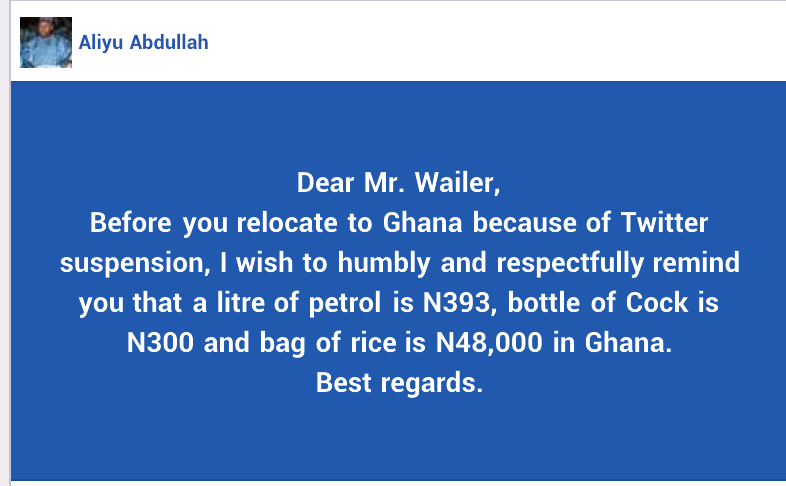
Special Assistant to the President on Media and Publicity to Aisha Buhari, Aliyu Abdullah, has thrown a distasteful jab against Nigerians who are angered by the federal government’s suspension of Twitter operations in the country. 

In a Facebook post he made on Sunday, June 6, Abdullah described the outraged Nigerians as wailers and reminded them that things are more expensive in other countries like Ghana. 

“Dear Mr. Wailer, Before you relocate to Ghana because of Twitter suspension, I wish to humbly and respectfully remind you that a litre of petrol is N393, bottle of Cock is N300 and bag of rice is N48,000 in Ghana. Best regards,” he wrote. 

Following the federal government’s announcement of a Twitter suspension,  Abdullah’s principal, Aisha Buhari on Saturday deactivated her Twitter account. 

 “I will be deactivating my twitter account for now. Long live Federal Republic of Nigeria,” she wrote before deactivating her account.

‘Nigerians sit and do nothing to challenge bad leaders’ – Cardinal Onaiyekan

0

Nigerians are used to “just sitting and complaining about everything” but do nothing to challenge bad leaders, says emeritus Archbishop of Abuja Catholic Archdiocese, John Cardinal Onaiyekan.

He urged Nigerians to put elected leaders on their toes and hold them accountable.

Mr Onaiyekan stated this on Tuesday in Abuja at the North Central Zonal Dialogue Conference, organised by Lux Terra Leadership Foundation, in partnership with Savannah Centre for Diplomacy, Democracy, and Development.

“Nigerians have gotten used to just sitting and complaining about everything. They complain about government and politicians, but they do not take their role of citizen participation seriously.

“The leaders are happy about this and take full advantage of the docile nature of most Nigerians,” he said.

According to the cleric, only when Nigerians actively use their right of “citizen participation” in governance will the leaders be on their toes and live up to their responsibilities.

The cleric reminded leaders that once they took their oath of office with either Bible or Quran, they had put themselves under the judgment of God.

Another panellist, Bola Abimbola, Executive Director of Savannah Centre, noted that some of the problems in the country stemmed from a trust deficit between the government and citizens.

Mr Abimbola, represented by Felix Pwol, a director at the centre, said the government needed to focus on national unity, national security, and development.

The Executive Director of Lux Terra, George Ehusani, said that the conference was a response to the ongoing widespread call for dialogue towards resolving Nigeria’s worsening socio-economic, political and security challenges.

The panellists included Olugbemiro Jegede, pioneer vice chancellor of the National Open University, and Audu Ogbeh, a former agric minister.

(NAN)

Donald Trump supports Buhari’s #TwitterBan

0

Former President of the United States, Donald Trump has hailed the decision of the Nigerian government to suspend the operations of Twitter in the country.

“Congratulations to the country of Nigeria, who just banned Twitter because they banned their President,” he said in the statement released on Tuesday.

Trump who has remained suspended by Twitter, Facebook and other social media giants for inciting American citizens said he wished he suspended Twitter operations while he was still in the office.

He urged more countries to follow the lead of Nigeria by standing up to the ‘evil’ social media companies.

“More COUNTRIES should ban Twitter and Facebook for not allowing free and open speech — all voices should be heard. In the meantime, competitors will emerge and take hold. Who are they to dictate good and evil if they themselves are evil? Perhaps I should have done it while I was President. But Zuckerberg kept calling me and coming to the White House for dinner telling me how great I was. 2024?” he added.

Nigeria suspends Twitter

The Federal Government last Friday suspended the operations of Twitter, the microblogging and social networking service, in Nigeria.

Lai Mohammed, Minister of information, announced the suspension in a statement.

According to the statement, the minister cited “the persistent use of the platform for activities that are capable of undermining Nigeria’s corporate existence”.

But many say that is only a cover and Twitter was suspended for deleting a tweet of President Muhammadu Buhari.

In the tweet which stirred outrage and was widely reported by Nigerians, the President made reference to the civil war while threatening to deal with violent agitators in the southeast region.

“Many of those misbehaving today are too young to be aware of the destruction and loss of lives that occurred during the Nigerian Civil War,” he tweeted.

“Those of us in the fields for 30 months, who went through the war, will treat them in the language they understand.”

Trump’s suspension

In January, Trump was suspended and has remained suspended by social media giants, Twitter, Facebook and Instagram for his ‘I will never concede’ speech that preceded violence as his supporters attacked the US Capitol.

Hundreds of Trump’s supporters attacked the US Capitol, the meeting place of the US Congress after Trump vowed to never concede at a speech in Washington.

The ‘Save America’ March which preceded the speech was organised to support Trump’s false assertion that the recent presidential election was rigged in favour of the winner, Joe Biden of the Democratic Party.

“All of us here today do not want to see our election victory stolen by emboldened radical Democrats,” Trump told a crowd of his supporters.

“We will never give up. We will never concede. It will never happen. You don’t concede when there’s theft involved. Our country has had enough. We will not take it anymore.”

“We will not let them silence your voices,” he said. “We’re not going to let it happen.”

Following the speech, the supporters stormed to the Capitol to overturn the presidential results and “take back our country” as Trump edged. Lawmakers were forced to scramble into desks and chairs as the police could not barricade the building.