

By: Olatunji Olaigbe
On the 20th of March, 2021, Jamiu Jibril, a visually impaired student sat to write his Master’s entrance examination at the Faculty of Arts, University of Ilorin. He had an aid who read out the questions and wrote down his answers for him, and like the non-special needs student sitting for the exam, he was given two and half hours.
Throughout Jibril’s academic journey, he has had to depend on the goodwill of other students and his extra-thrust for knowledge to go through school. The University of Ilorin, the same tertiary institution he got his graduate degree from, never provided him with special needs resources.
He remembers going to the university’s center for special students one day and being told “the center was for deaf students, and not the blind. Everything I did, every assistance I got, was on me,” says Jibril.
Like Jibril, special needs students in Nigerian tertiary institutions struggle against myriads of problems in the quest for education.
In a research by Abubakar Ahmed, Zakaria Al-Cheikh Mahmoud Awad, and Mastura Adam; Ahmadu Bello University (ABU) Zaria and Kano University of Science and Technology (KUST) were scored 26.7% and 13.3% respectively in their accessibility to the mobility impaired, noting: “Only 272 special schools, homes, centers, and integrated school cater for the education of Special needs children in Nigeria; a country whose Persons living With Disability (PWD) population was put at 19 million. Only 10% of the over 19 million disabled are receiving education in Nigerian educational environment.”
The 272 represents a totality of both special needs institutions, built specifically for special needs students, and seemingly “inclusive” institutions – meaning they provide education for non-special needs and special needs students. But how true is the statement?
In the University of Ibadan, the department of special education is a two-storey building with no ramps or supportive devices for special students other than the auditorily impaired. This makes it hard for students with other forms of disability to move around the building, getting education.
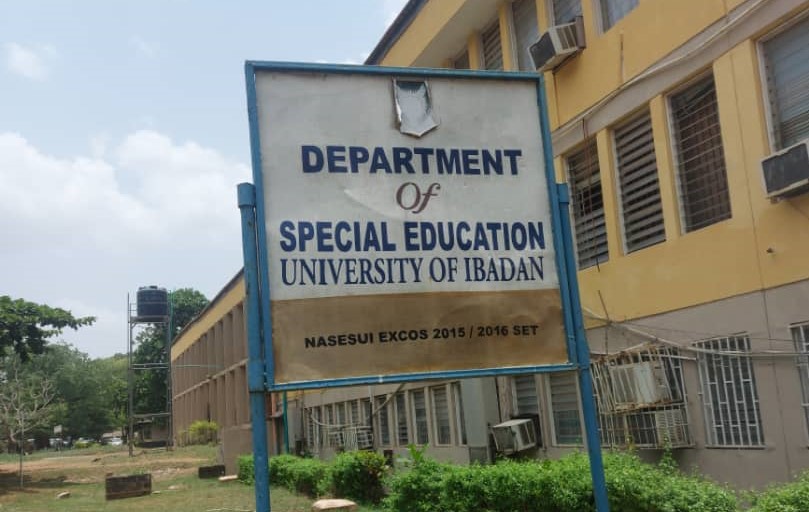
“Mobility impaired students have to stick to the lower floors and in unavoidable cases, they have to find someone who can assist them up the stairs”, says Nimi, a student of the department. “Even non-disabled students have issues getting education in the University, imagine what it’s like having a disability with that.”
The presence of PWDs in an institution does not directly translate into true inclusivity. Most institutions lack resources and infrastructure for special needs students. For Jibril, who has visited several institutions while representing his faculty, the University of Jos is the most special needs-friendly institution he’s seen, scoring 50% by his own discretion. “The University of Lagos could be scoring 80%, because they have a lot of resources and infrastructure, but they lack the motive to use these resources.”
A special needs-friendly institution for an auditorily impaired student can still be non-friendly to a mobility impaired, or a visually impaired student.
In the university of Benue, Akin, an auditorily-impaired student struggles in comprehending what is being taught because the university has no audio-to-sign language interpreter.
At the University of Ilorin, Victor, another auditorily impaired student of Computer Science Education faces a different shade of the same problem. The University of Ilorin provides interpreters, “but there are not enough,” says Victor. Citing that this places a lot of stress on the available interpreters. He added, “sometimes, the available interpreter is not familiar with me or the course being taught, [and then] misinterpretations happen.” For him, just as it is for every other student, getting what is being taught right is the tiny margin between a hardworking student and an intelligent one.
Quoting the answers to research questions by Education Data, Research, and Evaluation Nigeria (EDOREN):
The schools have facilities that meet the needs of all learners, such as separate toilets for girls, ramps (not stairs) for learners with physical disabilities and tactile floor guide: NO
“Teachers have high expectations for ALL children, believe they all can learn and encourage them to complete school: NO
Teachers know about the conditions that cause physical, emotional, and learning disabilities; and can help learners to get proper care: NO
Teachers adapt curriculum, lessons, and school activities to the needs of learners with diverse backgrounds and abilities: NO
Teachers adapt curriculum, lessons, and school activities to the needs of learners with diverse backgrounds and abilities: NO
Learners are involved to actively participate and develop guidelines/rules in the school to improve inclusion, reduce discrimination, violence and abuse: NO”.
Source: World Bank
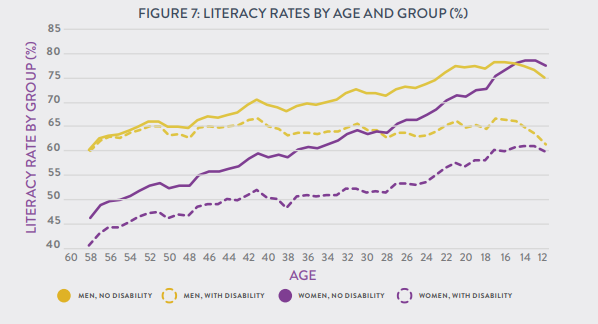
In place of the margin between literate and non-literate PWDs in Nigeria, the Joint Admission Matriculation Board (JAMB) implemented a policy encouraging institutions to make 10% of their population PWDs, “but I can assure you that’s not the reality,” says Jibril.
In 2015, Nigeria introduced the National Policy on Special Needs Education, its first document fully dedicated to the interests of people with special needs.
In 2016, it also introduced the National Policy on Inclusive Education, which aimed to provide education to everyone. Promising to “offer a quality education for all while respecting diversity”. The policy defined itself as “about removing barriers to learning and involving all learners who otherwise would have been excluded through marginalization and segregation.”
On 17th, January 2019, President Muhammed Buhari signed the Discrimination Against Persons with Disabilities (Prohibition) Act – even promising the conversion of existing building structures into inclusive ones.
But most of these policies are lost in transition, not being translated into actions.
“There’s a need for more inclusivity policies, but more need for the enforcing of already existing policies. There’s a need for institutions to improve on their inclusivity.” says Dr. Azubike Onuora-Oguno, a Teaching Research Fellow on Human Rights Law and Society at the International Institute of Social Sciences, Netherlands. And a senior project manager of the Disability Law Advocacy Project – an Open Society Initiative of West Africa (OSIWA) project aimed to make academic curriculums in Nigerian Universities special needs friendly.
The majority of problems come from the government, but the public has a part to play too. “We all have an obligation to accommodate PWDs, but this can’t happen until we understand the concept. Parents, people have to understand that PWDs are humans, meant to be acknowledged as such,” says Dr. Azuibike. “Generally, there’s a need for deep-seated sensitization that will make us act reasonably towards PWDs.”
“We need understanding, EMPATHY, not SYMPATHY,” types Abiola Dada, a special needs student at the University of Ilorin.
Jibril is a broadcaster at Royal FM, Ilorin, and when Jibril isn’t busy with work or academics, he tutors other students in his Faculty. “On most days, the university is crowded. There’s the bus fight, students literally gnawing their way through the queue. What happens to me? Do I sleep in school?” Asks Jibril.


